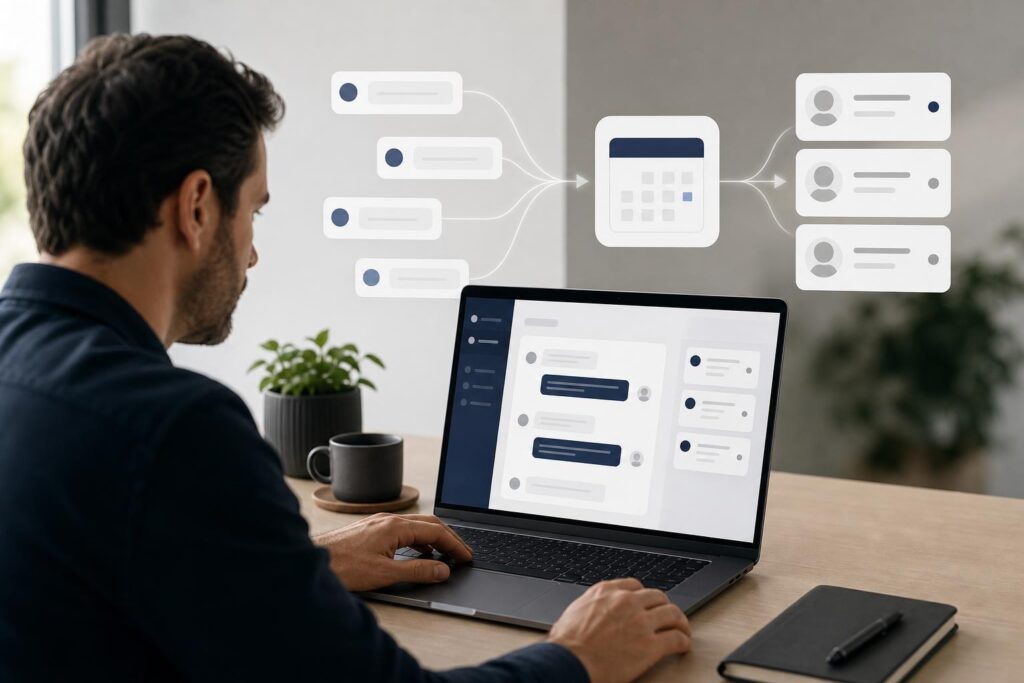
A potential customer visits your website with a straightforward question: Do you serve my area? How much does the service usually cost? Can you help with this specific problem? What should I do before booking?
If the answer is not immediately available, the visitor may submit a form, call during business hours or leave for another provider. For a busy local-service business, that creates a frustrating gap: the team knows the answers, but cannot personally respond to every question at the moment it is asked.
An AI customer service bot can help close that gap. When trained on the business’s actual services, pricing guidance, policies, frequently asked questions and booking process, it can handle routine conversations while moving qualified prospects toward a sensible next step.
The goal is not to replace human judgment. It is to stop making every interested visitor wait for information your business has already documented.
Why repetitive questions become a lead-conversion problem
Most service inquiries are not initially complex. Prospects often need enough clarity to decide whether contacting or booking the business is worth their time.
Common questions include:
- Whether the business provides a particular service
- Which locations or service areas are covered
- What pricing factors affect an estimate
- What availability or booking steps look like
- Which information the customer should prepare
- Whether a policy applies to their situation
- How to reschedule, cancel or request additional help
Leaving these questions unanswered creates friction at the exact moment someone is evaluating the business. A contact form does not always solve the problem because it asks the visitor to wait. A long FAQ page may contain the answer, but the prospect still has to find and interpret it.
A trained bot changes the interaction from “search and wait” to “ask and proceed.” It can surface relevant information conversationally, capture useful lead context and explain the next booking step without forcing the visitor to navigate several pages.
What an AI customer service bot should—and should not—handle
The best starting point is not “automate every conversation.” It is identifying the predictable questions that consume time or cause prospects to abandon the process.
Good tasks for a trained bot
- Explaining services in clear, customer-friendly language
- Answering approved questions about pricing or pricing factors
- Clarifying service areas, basic policies and preparation requirements
- Helping visitors identify the most relevant service
- Collecting contact details and basic information about the request
- Directing an interested lead to the documented booking process
Conversations that need human judgment
Unusual project requirements, sensitive complaints, exceptions to policy, final estimates and situations involving professional judgment should remain with the appropriate person. The bot should not improvise an answer simply to keep the conversation moving.
A useful rule is simple: let the bot handle repeatable information and early-stage qualification, then make the boundary for human review clear. This protects the customer experience while still reducing avoidable back-and-forth.
A practical conversation flow from question to booking
A productive bot conversation does more than display FAQ answers. It gives the prospect a short, logical path forward.
- Identify the visitor’s need. Start with a simple question about the service or problem instead of presenting a large menu.
- Provide a relevant answer. Use information approved by the business, including important conditions or limitations.
- Collect useful context. Ask only for details that help determine fit or prepare the team for follow-up.
- Clarify the next step. Explain how to request an estimate, consultation, appointment or other appropriate action.
- Set expectations. Tell the visitor what happens next rather than ending with a vague confirmation.
For example, a home-service visitor might ask whether a repair is available in their area. The bot can explain the documented service coverage, ask for the location and type of issue, collect contact information, and then point the visitor toward the business’s booking or follow-up process.
An AI customer-service and lead-capture bot from Elite UI can be trained around a business’s services, pricing, FAQs, policies and booking steps. That makes it relevant for teams that want the conversation to reflect how their business actually operates rather than rely on generic responses.
How the workflow changes by service business
The underlying structure is consistent, but the useful questions vary by industry.
Home and property services
A cleaning company, contractor or maintenance provider may need to identify the property type, service area, requested work and desired timing. The bot can explain which services are offered and gather the details needed for the team to evaluate the inquiry.
Professional services
A consultant, agency or accounting practice may need to understand the prospect’s business, current challenge and type of engagement. The bot can clarify service categories and help the visitor choose the appropriate consultation path without offering professional advice.
Beauty, wellness and appointment-based businesses
Visitors may ask about service differences, preparation, general policies or which option fits their goal. The bot can provide approved guidance and direct the prospect toward the correct booking steps while leaving personal recommendations to a qualified team member.
Real estate and local sales teams
A bot can distinguish between buyers, sellers, renters or property owners and collect basic preferences. It should help organize initial intent, not replace the conversations and judgment involved in a real estate transaction.
What the bot needs to learn before it goes live
A bot is only as useful as the business information behind it. Before implementation, gather the materials that already guide customer conversations:
- A current list of services and who each service is for
- Approved pricing information or the factors that determine a quote
- Service areas and relevant limitations
- Frequently asked questions written in plain language
- Cancellation, rescheduling, refund or appointment policies where applicable
- Booking steps and what customers should expect afterward
- Questions that must be referred to a team member
Conflicting or outdated information should be resolved first. If one page says the business covers an area and another says it does not, automation will not fix the underlying content problem.
The website also needs a clear destination for the conversation. If the current site makes services or next steps difficult to understand, improving it with a conversion-focused AI Website Builder can support the bot rather than expecting the conversation alone to compensate for a confusing customer journey.
Common concerns before using an AI bot
“Will it give customers incorrect information?”
This is primarily a training and scope question. The bot should be grounded in current, approved business information and limited where human judgment is required. Teams should review likely questions, ambiguous phrasing and policy exceptions before relying on the workflow.
It is also important to maintain the source information. When services, prices, policies or booking steps change, the bot’s training should be updated accordingly.
“Will the experience feel impersonal?”
It can if the conversation is too long, overly scripted or designed to block access to the business. A better experience gives direct answers, asks only necessary questions and makes the next step obvious.
Many visitors do not need an extended conversation. They need a fast answer and a clear way to continue. Human support remains important for nuanced decisions, reassurance and relationship-building.
“Do we need to automate booking?”
No. Moving a lead toward booking does not have to mean completing every appointment action inside the conversation. The bot can explain the process, gather relevant details and direct the prospect to the business’s established next step. The right scope depends on the existing workflow.
Is an AI customer service bot a fit for your business?
A trained bot is worth considering when several of these conditions are true:
- Your team repeatedly answers the same pre-sale questions
- Leads arrive when staff cannot respond immediately
- Prospects need clarification before they are ready to book
- Your services, policies and booking steps can be documented clearly
- Your contact forms capture too little context for an efficient follow-up
- Your team wants to spend more time on qualified or complex conversations
It may not be the first priority if the business has not defined its services, frequently changes core policies or requires expert judgment from the first interaction. In that case, document the customer journey and decision rules before adding automation.
Turn your repeated answers into a usable lead path
Start by reviewing recent calls, emails and website inquiries. Identify the ten questions that appear most often, the information needed to assess fit and the exact action a qualified prospect should take next. That becomes the foundation for a focused bot experience.
If slow replies and repetitive questions are causing promising visitors to disappear, Elite UI can help you discuss a bot trained around your real services, pricing, FAQs, policies and booking process. Request an AI Bot.
Ready to Turn This Into a Faster Workflow?
Try AI Customer Service Bot inside Elite UI and move from research into a real business-ready result.
Product features, pricing, plan details and availability may change. Check the current Elite UI product page for the latest information before purchasing or publishing.