
A rough software idea often sounds convincing in conversation but becomes harder to explain once someone asks to see the product. The concept may solve a real problem, yet the screens, workflow, positioning and next steps are still unclear.
This is where many founders and small teams lose momentum. They either start building too much before validating the core experience or assemble disconnected screens that do not help customers understand the product.
The goal is not to make every possible feature launch-ready. It is to create a focused, credible experience that shows the right customer what the product does, why it matters and how to complete its central task.
Define what “customer-ready” means for your product
A customer-ready product is not necessarily a feature-complete product. It is an experience coherent enough for a prospective user, buyer, investor or internal stakeholder to understand and evaluate without the founder narrating every step.
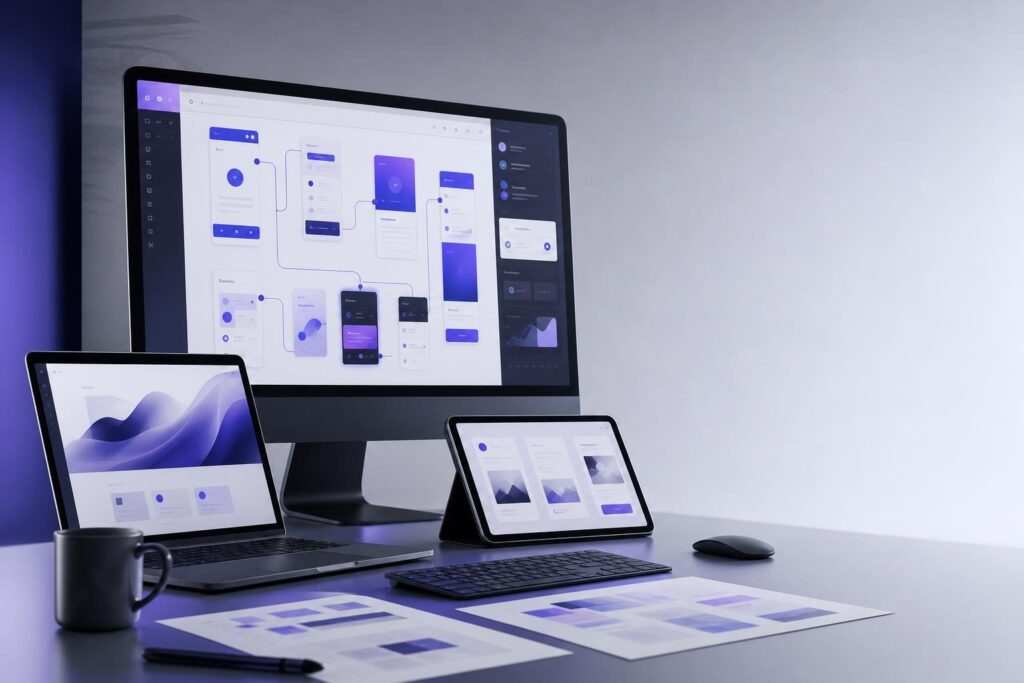
That experience could be a working SaaS interface, a clickable product design, an AI editor concept, a conversion-focused landing page or a more complete combination of product and marketing surfaces. The appropriate deliverable depends on what you need to learn or accomplish next.
Before discussing screens, decide which outcome matters most. Are you trying to collect qualified inquiries, test whether users understand a workflow, present the concept to stakeholders or prepare a more defined direction for development?
A clear answer prevents the project from becoming an expensive collection of ideas. It also establishes a practical test: can the intended audience understand the value and move through the core journey with minimal explanation?
A seven-step roadmap from concept to product experience
- Identify the customer and triggering problem. Describe who experiences the problem, what causes them to seek a solution and what they currently do instead. “A platform for service businesses” is broad. “A workspace that helps a small home-services team organize incoming quote requests” provides a clearer design direction.
- Choose one core customer outcome. Decide what a user should be able to accomplish in the first meaningful version. An ecommerce analytics product might help a store owner identify where a sales funnel is losing buyers. An AI editor might help a marketer create, revise and export one type of business asset. Secondary ideas can wait.
- Map the shortest credible journey. Outline the steps from arrival to outcome. This may include discovering the product, understanding its value, creating or entering an account, providing an input, reviewing a result and choosing what to do next. Remove steps that do not support the main outcome.
- Turn assumptions into product decisions. Document what the design assumes about the customer. Do users already understand the category? What information must they provide? What might make them hesitate? Which result will feel valuable? These questions influence onboarding, interface labels, empty states and calls to action.
- Establish a visual and interaction system. Colors and typography matter, but consistency matters more. Buttons, navigation, forms, panels, feedback states and content hierarchy should behave predictably. A reusable system also makes it easier to expand the product without redesigning every screen independently.
- Design the critical states, not only the ideal screen. A polished dashboard filled with perfect data is easy to admire but does not represent the whole experience. Consider what users see before they add information, while a process is underway, when an input is incomplete and after an action succeeds.
- Connect the product to its buying experience. The landing page and product interface should tell the same story. If the page promises a simple workflow but the interface feels dense and technical, confidence drops. Product positioning, feature explanations and calls to action should match what the experience can support.
Prioritize workflows before building a long feature list
Feature lists encourage teams to think in isolated components: dashboard, messaging, analytics, exports and administration. Customers experience products as workflows instead. They arrive with a goal, provide information, make decisions and expect a useful result.
For example, a real estate product does not become valuable merely because it has property cards, filters and a map. The design must help a particular user move from a broad search to a manageable shortlist and a confident next action.
Likewise, a creator tool with multiple editing controls still needs a clear path from blank canvas to finished asset. A local-service platform needs more than a lead table; it needs a logical way to review a request, understand urgency and follow up.
When the workflow is clear, it becomes easier to distinguish essential product behavior from features that can be explored later.
Decide what should be designed first
Start with the surfaces that carry the greatest decision risk. If customers may not understand the offer, begin with positioning and the landing page. If the main uncertainty is whether a complex task can feel manageable, focus on the product workflow. If stakeholder alignment is the obstacle, create a structured interface direction that makes the concept tangible.
This is also the point where specialized support can prevent costly drift. Elite UI’s Custom Website & Product Design service is intended for businesses that need more than a template or self-serve tool, including custom websites, landing pages, AI editors, SaaS interfaces and broader product-design inquiries.
The value of custom work is not simply receiving more screens. It is being able to connect business goals, customer needs, content hierarchy and interface decisions around one coherent experience.
Validate comprehension before adding depth
Early validation does not require pretending the product is finished. Show the proposed journey to people who resemble the intended customer and ask them to explain what they believe the product does, where they would begin and what they expect after each action.
Avoid leading questions such as “Would this button help you generate a report?” Instead, ask “What would you do next?” or “What do you expect to happen here?” Their interpretation reveals more than general expressions of enthusiasm.
Look for repeated friction. If several people misunderstand the same label, fail to notice the primary action or cannot distinguish setup from output, revise the experience before expanding it.
Feedback should inform judgment rather than turn every suggestion into a requirement. A disciplined product direction solves the most important recurring problems without becoming a compilation of individual preferences.
When a self-serve tool is enough—and when it is not
Self-serve tools make sense when the business model is straightforward, the required page structure is familiar and the team can confidently choose its content, hierarchy and visual direction. For example, a founder validating a simple service offer may be able to use an AI Website Builder to establish an initial web presence.
Custom design becomes more relevant when the interface itself is part of the product, the customer journey is unusual, multiple audiences need different paths or the project must combine product behavior with a persuasive marketing experience.
It may be a fit if:
- Your idea is clear at a high level, but the core user journey is still difficult to translate into screens.
- Your current product works functionally but feels inconsistent, confusing or difficult to present to customers.
- A template cannot represent the workflow or positioning without substantial compromises.
- You need a tailored landing page, SaaS interface, AI editor or connected product experience.
- Your team needs a more concrete design direction before making additional build decisions.
If you only need a conventional brochure-style site and already know exactly what it should contain, a self-serve route may be the more proportionate starting point. Custom work should address genuine complexity or business importance, not add complexity for its own sake.
Common questions before investing in custom product design
Do I need every requirement finalized first?
No, but you should be able to explain the customer, the problem and the most important outcome. Product design can help resolve open questions, yet it cannot compensate for an idea with no identifiable user or purpose. Bring existing notes, sketches, references and constraints, even if they are incomplete.
Will custom design make an unvalidated idea successful?
Design can make a concept clearer, more usable and easier to evaluate. It cannot guarantee demand or replace customer research, positioning and business judgment. The strongest process treats design as a way to test and express a focused product hypothesis—not as proof that the market will accept it.
Should I design the product or the landing page first?
That depends on the biggest unknown. If the challenge is explaining the value, begin by clarifying positioning and the buying journey. If the key risk is whether the workflow makes sense, establish the product experience first and let the landing page reflect it. In many projects, both evolve together.
What if the product will change after launch?
Change is expected. A useful design direction should create consistency without assuming that every future feature is known today. Concentrate on the core workflow and reusable interface patterns, then revisit the experience as real customer behavior creates better evidence.
Prepare a useful brief for a custom design conversation
You do not need a formal specification to start, but a concise brief will make the first conversation more productive. Explain who the product serves, the problem it addresses, the central action users should complete, what exists today and what decision or milestone the project needs to support.
Include rough sketches, competing approaches you have considered and examples of experiences you find clear. References should communicate preferences rather than request a copy of another product.
Most importantly, identify the parts you are unsure about. Those uncertainties often reveal where strategic product-design thinking can contribute the most.
Move from explanation-dependent to customer-ready
A promising concept becomes a credible product experience when customers can recognize the value, navigate the essential workflow and understand the next step without constant explanation. Reaching that point requires focused scope, deliberate interface decisions and alignment between the product and the way it is presented.
If your website or software concept has outgrown templates and disconnected mockups, Request a Custom Build to discuss a tailored website, landing page, SaaS interface, AI editor or product-design direction with Elite UI.
Ready to Turn This Into a Faster Workflow?
Try Custom Website & Product Design inside Elite UI and move from research into a real business-ready result.
Product features, pricing, plan details and availability may change. Check the current Elite UI product page for the latest information before purchasing or publishing.