

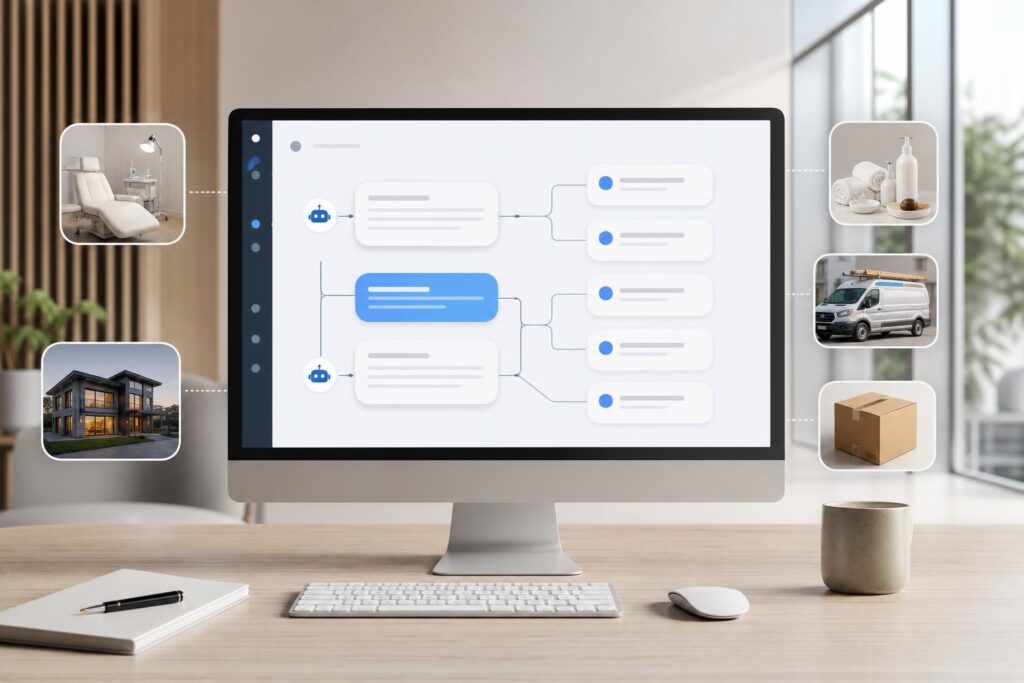
A prospective customer visits your website with a straightforward question. They want to know whether you serve their area, offer a specific treatment, accept a type of project or allow returns. If the answer is difficult to find, that visitor may leave before your team has an opportunity to respond.
An AI customer service bot can close this communication gap, but only when it has a clearly defined role. The useful question is not simply, “Can we add a bot?” It is, “Which customer conversations are repetitive, time-sensitive and structured enough for a bot to handle well?”
The answer varies significantly across medical practices, med spas, real estate businesses, home service companies and ecommerce stores. Each has different buying journeys, risks and escalation points. The following use cases show where automation can help capture demand without asking it to replace professional judgment or personal service.
Start with the conversation, not the industry
Businesses often approach automation by trying to make a bot answer everything. That creates an unnecessarily large project and increases the risk of vague, inaccurate or inappropriate responses.
A better starting point is a narrow group of high-volume conversations. Strong candidates generally share three characteristics:
- The answer is repeatable. It comes from established services, pricing guidance, policies, FAQs or booking steps.
- The visitor has clear intent. They are evaluating a purchase, appointment, consultation or service request.
- There is a defined next step. The bot can explain what to do, collect lead details or identify when the person needs help from the team.
Before selecting use cases, review the questions arriving through contact forms, calls, social messages and email. Look for questions that consume staff time but rarely require case-by-case judgment. Those are usually better automation candidates than uncommon or sensitive conversations.
1. Medical practices: handle administrative questions, not clinical decisions
For doctors and other medical practices, the safest and most useful starting point is administrative guidance. Website visitors often need basic information before they are ready to contact the office.
A trained bot could help explain:
- Services or appointment types offered by the practice
- Office hours, locations and general preparation instructions supplied by the business
- The practice’s published scheduling or cancellation process
- What information a new patient should prepare before contacting the office
- How to reach the appropriate person for billing or administrative support
The boundary matters. A customer-service bot should not be positioned as a physician, diagnose symptoms or give individualized medical advice. Urgent, clinical and highly personal questions need an explicit path away from automated conversation and toward qualified human assistance.
Medical businesses should also assess their privacy, compliance and record-handling requirements before deciding what information a website conversation should collect. A narrowly scoped administrative assistant is more realistic than a bot expected to manage every patient interaction.
2. Med spas: turn treatment research into a qualified inquiry
Med spa customers often research several services before speaking with a provider. Their questions may concern treatment categories, general eligibility, preparation, recovery expectations, pricing structure or consultation steps.
A bot trained on approved service information can help visitors navigate those options without forcing them to search across multiple pages. It can clarify which services the business offers, explain the published consultation process and collect the details the team needs for a follow-up.
This is where an AI customer service and lead-capture bot from Elite UI can support a defined pre-consultation workflow. The bot can be trained around the business’s services, pricing, FAQs, policies and booking steps rather than responding from an undefined pool of information.
As with medical practices, treatment suitability and clinical recommendations belong with a qualified professional. The bot’s job is to organize the initial inquiry, reduce repetitive administrative exchanges and help a serious prospect reach the correct next step.
3. Real estate: qualify intent before an agent follows up
Real estate websites attract visitors at very different stages. One person may be ready to schedule a showing, while another is only exploring neighborhoods or learning how the selling process works.
A focused bot can ask a short sequence of non-invasive questions to understand the inquiry. For a buyer, that could include the desired property type, broad location preference, general timeline and preferred contact method. For a seller, it could identify whether they want information about listing steps, a consultation or help with a particular type of property.
It can also answer repeatable questions about the agency’s services, service areas, consultation process and published policies. This gives agents more context before they respond and gives visitors a path forward when an agent is unavailable.
The bot should not make promises about property availability, valuations, financing eligibility or transaction outcomes unless the business has a reliable and approved process for providing that information. Its strongest role is initial guidance and lead qualification, not replacing an agent’s advice.
4. Home services: clarify fit before dispatch or estimation
Plumbers, electricians, landscapers, cleaners, roofers and other home service providers regularly receive incomplete inquiries. A message such as “How much does this cost?” is difficult to answer without knowing the location, service category, urgency or scope.
A lead-capture bot can create a more useful first exchange by asking for the information the business normally needs, such as:
- The requested service
- The relevant service area
- Whether the need is urgent or planned
- A concise description of the issue or project
- The visitor’s preferred follow-up details
It can also explain published service boundaries, estimate procedures, operating hours and booking steps. That does not mean the bot should invent a quote or guarantee an arrival time. Complex pricing, emergency triage and final scheduling should remain aligned with the company’s real operating process.
If the surrounding website does not clearly explain services or guide visitors toward action, the bot will have to compensate for weak pages. Businesses rebuilding that customer journey can pair the conversation plan with a more focused AI Website Builder workflow.
5. Ecommerce: remove pre-purchase uncertainty
Ecommerce stores lose potential orders when product information or policies are difficult to locate. A customer may need to understand sizing guidance, product differences, shipping rules, return policies or which item best matches a stated need.
An ecommerce bot can answer general questions based on approved product and policy information. It can direct shoppers toward relevant categories, explain published shipping and return terms, and help visitors identify the next step when they need personal assistance.
Order-specific questions are a separate decision. Answering “Where is my order?” may require access to current order data and supporting systems. Do not assume that every bot includes those connections. Confirm the technical requirements and available workflow before promising account-specific answers.
For many smaller stores, the highest-value starting point is simpler: help visitors choose confidently before purchase and make important policies easier to understand.
How to choose the first conversations to automate
Do not begin by writing hundreds of possible answers. Build a small conversation brief based on real demand.
- Collect recurring questions. Review recent inquiries and group them by topic.
- Mark high-intent questions. Prioritize conversations that commonly happen before a booking, quote, consultation or purchase.
- Identify the approved source. Every answer should trace back to current service information, pricing guidance, policies, FAQs or booking instructions.
- Define escalation points. Decide which topics require staff involvement, including sensitive, urgent, unusual or complaint-related conversations.
- Specify lead fields. Collect only the details the team genuinely needs to continue the conversation.
- Assign ownership. Choose who will review the bot’s source information when services, prices, policies or processes change.
This approach creates a manageable first version. It also makes evaluation easier because the business can review whether the bot is answering the intended questions and collecting useful inquiries.
Common objections and decision questions
Will the bot make the business feel impersonal?
It can if it blocks access to people or pretends to have expertise it does not possess. A better experience sets expectations, answers routine questions clearly and provides a sensible route for conversations requiring human judgment. The goal is not to remove personal service; it is to make that service easier to reach with better context.
What if the bot gives an outdated answer?
A bot is only as dependable as the information used to train and maintain it. Assign responsibility for reviewing services, pricing, FAQs, policies and booking steps. When an answer depends on changing availability or individual circumstances, the bot should avoid presenting a fixed response as certain.
Should it answer every question?
No. Clear limits improve the customer experience. Medical advice, legal interpretation, emergency decisions, custom estimates and unusual complaints are examples of areas where escalation may be more appropriate than automation.
Is an AI customer service bot a fit for your business?
A trained bot is worth considering when your business receives recurring website questions, loses inquiries outside normal response windows, or spends significant staff time gathering the same basic details. It is especially relevant when customers need guidance before they can choose a service or contact the right person.
It may not be the immediate priority if your service information changes constantly, your website attracts very little qualified traffic, or nearly every inquiry requires specialist judgment from the first sentence. In those cases, clarify the offer and customer path before automating the conversation.
The strongest implementations have a focused purpose, approved source material and clear human boundaries. If your team can identify the questions, answers and next steps, Elite UI can help you discuss a bot trained around that real customer journey. Request an AI Bot.
Ready to Turn This Into a Faster Workflow?
Try AI Customer Service Bot inside Elite UI and move from research into a real business-ready result.
Product features, pricing, plan details and availability may change. Check the current Elite UI product page for the latest information before purchasing or publishing.